
Project-owned sample · reference snapshot 2026-08-31
A fit report
you can inspect.
This concrete example applies the USD 250 sprint format to Local Knowledge Terminal's own documented reference collection. It shows the three deliverables before you share any customer material.
Evidence boundary: this is not a customer result, testimonial, benchmark, sale, or claim of a paid engagement.
Decision summary
GO, with a bounded scope.
The existing structured records fit LKT's local exact and lexical retrieval plus cited-card workflow on the current Raspberry Pi 5 8 GB target. The useful first proof is a browser card backed by one retrieved record and its stored provenance.
Do not expand this decision to image-only PDFs, custom OCR, unreviewed rights, hardware supply, or production operations. Those require a separate scope.
Deliverable 01
Collection, privacy, and citation map.
The public proof uses five reviewed exports. Full books, images, model weights, generated indexes, and editorial queues remain outside the public repository.
| Collection export | Records | Runtime treatment |
|---|---|---|
| Word Origins | 6,994 | Exact headword and lexical FTS5 |
| Book of Answers | 318 | Deterministic query-seeded draw |
| Book of Questions | 291 | Multilingual FTS5 and deterministic fallback |
| English Root Dictionary | 4,018 | Exact headword and morphology FTS5 |
| English Affix Dictionary | 5,179 | Exact headword and morphology FTS5 |
| Total | 16,800 | Five local indexes; derived indexes remain outside Git |
owned source files→
reviewed export→
local SQLite index→
retrieved record + source ID→
bounded composition→
browser card
What remains local
- Private source files and generated indexes.
- Model weights and runtime state.
- Editorial workspaces and review queues.
What a citation retains
- Corpus and record identifiers.
- Source title, excerpt, and page when present.
- The indexed-file hash used for retrieval.
Deliverable 02
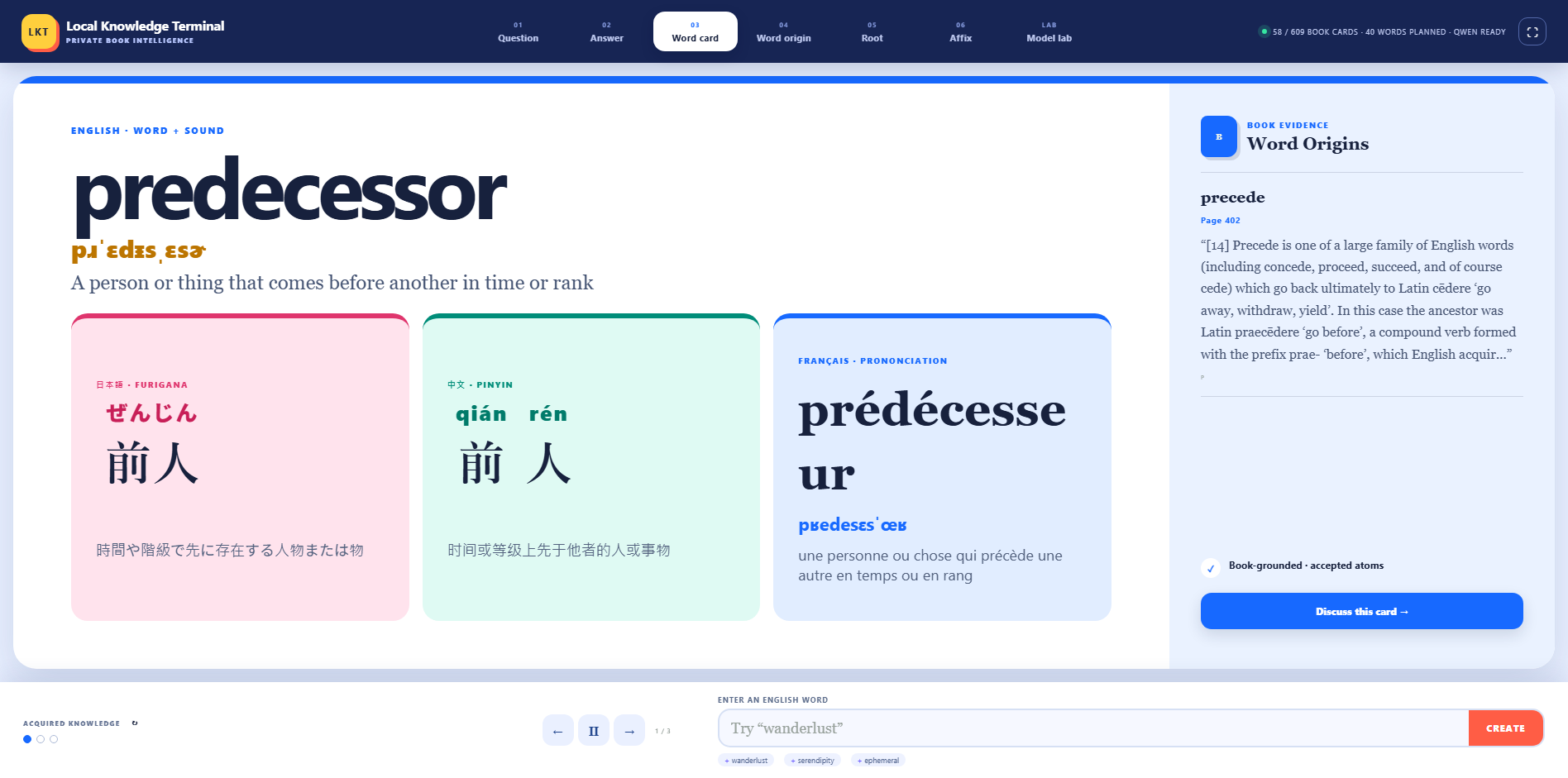
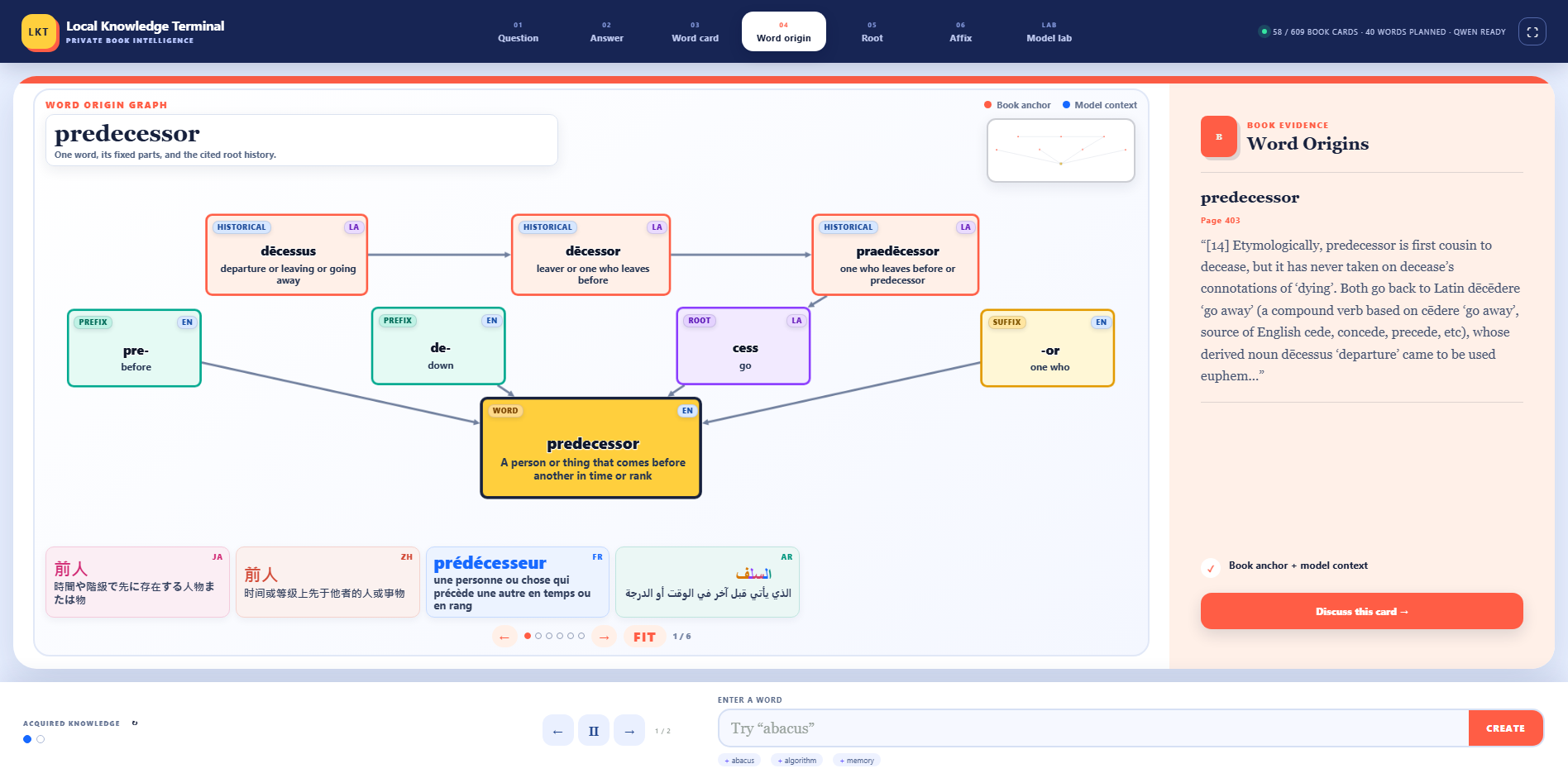
Representative browser proof.
These reviewable captures use the current card contract. A paid sprint would instead use only a small, customer-approved sample after rights, format, privacy, readers, language goal, and existing hardware pass the free fit check.
Deliverable 03
A written go/no-go boundary.
Go when
- You control the bounded source and have the right to use it.
- Text is already extractable or structured.
- A representative sample can be reviewed.
- The goal is a small cited browser proof on an existing machine.
- One language goal and reader group can be stated clearly.
No-go or separate scope
- Source rights are unclear.
- The material is mainly scanned images requiring custom OCR.
- The request is an unbounded migration or production platform.
- Shipped hardware, uptime commitments, or a production SLA are required.
- The sample needs an unapproved handling environment.
Research-PDF variant
Four synthetic PDFs, one inspectable decision.
A second project-owned sample executes the PDF-specific path: local extraction, duplicate and version handling, a fixed lexical query set, and citations that return to an exact document version and page.
What it runs
- One exact duplicate and one retained v1/v2 family.
- English, Simplified Chinese, and Japanese text.
- Twenty fixed questions, including one deliberate vocabulary miss.
What every accepted result keeps
- Document ID, version, PDF page, and source snippet.
- Extraction method and source-file SHA-256.
- An explicit no-go boundary for OCR, semantic claims, and full deployment.
The fixed paid scope
One collection. Three bounded artifacts. USD 250.
After a positive free fit check, the sprint delivers a written data, citation, and privacy map; evaluates an agreed sample capped at 12 source units and 20 test questions; builds up to two cited browser cards when usable; and gives a written go/no-go decision. One factual correction pass is included. Hardware, shipping, custom OCR, bulk conversion, production deployment, and ongoing support are excluded.
Start the free fit check
Nothing is sent while you fill in or review the fit check. Continue by sending the encrypted request here, opening it in your email app, or copying it.
Reproduce the public checks
python -m unittest discover -s tests -v
python -m compileall -q lkt tests
The tests cover indexing, retrieval, provenance, preparation, model boundaries, storage, outputs, and the browser service. They demonstrate the public implementation; they do not substitute for checking a customer's actual sample.
Read the source report and corpus ledger →