
Parallel-text history · 文言文 · English · 日本語 · 中文
Keep the original. Keep your place.
I built a public reading shelf where Classical Chinese sits beside English, modern Japanese, and modern Chinese. Start with 資治通鑑, then move through the histories at your own pace.
Read in the browser or choose a pocket-size PDF.
What is on the shelf
Five paths into the histories.
資治通鑑 is available as six black-and-white parts. The other histories below have both color and black-and-white editions. Each keeps 文言文 as the main text with English, modern Japanese, and modern Chinese alongside it.
Six parts · black-and-white
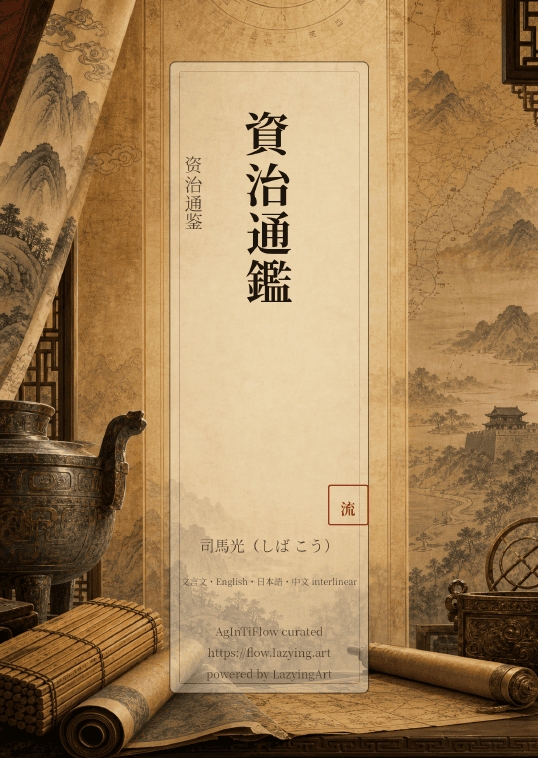
資治通鑑
A long chronological history, divided into six parts so you can enter it without carrying the whole work at once.
Color · black-and-white
漢書
The history of the Former Han.
Three parts · two formats
後漢書
The history of the Later Han.
Color · black-and-white
三國志裴松之注
The Records of the Three Kingdoms with Pei Songzhi's commentary.
Color · black-and-white
春秋左氏傳
Narrative history and commentary around the Spring and Autumn period.
A way to read
Use the translations as a handrail.
Read a short original passage first. Mark the particle, name, or reference that breaks the sense. Compare the other languages only when you are stuck, then return to 文言文 and restate the passage in your own words.
- ReadStay with one short original passage.
- MarkFind the exact place where the thread breaks.
- CompareUse the parallel languages to test your reading.
- ReturnGo back to the original and explain it plainly.
Why four languages
Each one reveals a different choice.
Classical Chinese preserves the compression. English often makes the sentence structure explicit. Modern Japanese and modern Chinese illuminate different continuities in wording, names, and interpretation. None replaces the original; together they make it easier to return to it.
Keep the source in view
The page is organized around 文言文, so help never becomes a substitute for reading.
Compare, do not merely accept
Differences between languages are prompts to inspect the original more closely.
Return and restate
The useful test is whether you can explain the passage after the parallel text is gone.
Built with PocketPolyglot
The books and the pipeline are both inspectable.
LinguaLeaf holds the reading editions. PocketPolyglot holds the tools and structured workflow used to assemble aligned multilingual books, pronunciation aids, and pocket-size layouts.
Check each edition's source notes before redistributing it.